BLOG
From Detachment to Encounter: Wine Education in the Age of Resilience
Julien Camus
Blog
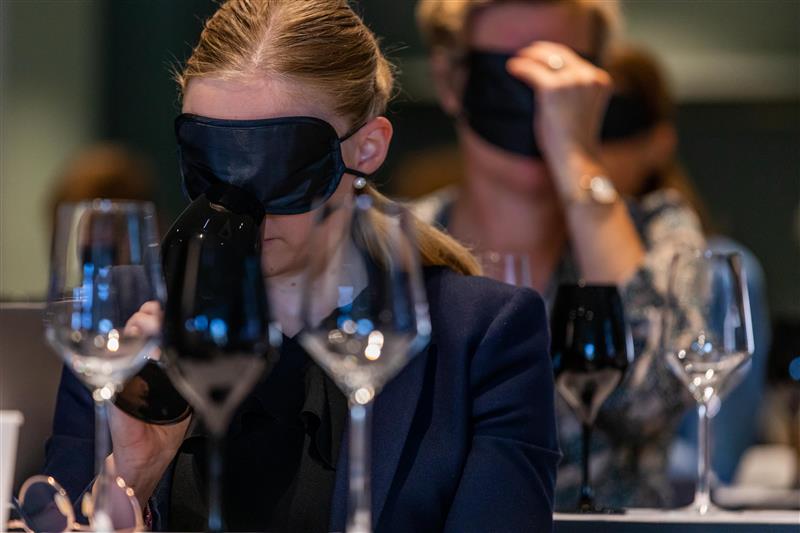
Picture a wine student in an exam, glass in hand, working methodically through the grid: clarity, intensity, aroma, palate, structure. She's been trained to be objective, to leave her biases at the door, to divide the whole into its component parts: acidity, tannin, fruit, oak—and reassemble them into a neat summation. She might even get the ‘right’ answer, but has she actually tasted the wine?
This scene plays out in tasting rooms and wine schools around the world, every day. It's the foundation of modern wine education: systematic, analytical, replicable. And for certain purposes—building vocabulary, developing sensory memory, passing standardized exams—it works. It corresponds perfectly to the reductionist paradigm from which it springs. And yet, something essential is missing. Wine becomes an object to be decoded and dominated rather than an experience to be lived and moved by. The taster becomes a technician rather than a participant.
The Reductionist Trap
Traditional wine education rests on three assumptions that appear self-evident but are, on closer inspection, deeply problematic. The first is the illusion of objectivity. We're taught to taste ‘neutrally,’ as if our sense perceptions and our ability to communicate them were mirror reflections of a wine's ‘true’ properties. But there’s a long tradition, from Kant’s Critique of Judgement through contemporary neuroscience, that tells a different story: knowledge is always constructed, shaped by our human faculties, our cultural conditioning, our memories, even the weather and our mood. The idea of a pure observer is pure fiction. When we pretend to taste objectively, we're not eliminating bias—we're just sweeping it under the rug.
The second assumption is what we might call the dissection fallacy. Standard wine education trains us to isolate components—acidity here, tannin there, fruit, oak, and so forth—as if these were independent variables that can be examined in themselves and then added up to give a summation of a wine. This works reasonably well for standardized, industrial wines engineered to fit predictable profiles. But the wines that move us, that stay with us, that teach us the most, don't work this way. Their power lies in their relational dynamics: harmony, tension, personality, soul. Such qualities can't be reduced to components—they emerge from the interplay of the whole.
Assumption three is the tyranny of typicity. Students learn what wines are 'supposed' to taste like—canonical Chablis, textbook Barolo, quintessential Napa Cabernet. This Pavlovian conditioning creates a template against which all wines are judged, flattening nuance in the pursuit of predictability. Wines that don't fit the mold are dismissed as atypical, flawed, or confused. But the most inspiring wines often bend and blur these categories. Moreover, these standardized models tend to reflect commodity wines—wines engineered to fit predictable profiles and tick prescribed boxes—rather than the authentic, place-based wines that carry the most meaning and emotional resonance.
These three assumptions aren't just pedagogical quirks, nor is this just abstract theory or finger pointing. At Wine Scholar Guild, as we mark our 20th anniversary, we've been asking ourselves these same questions: What does it mean to teach wine in an age of resilience rather than efficiency? How do we honor depth while also cultivating discernment, context, and critical engagement? The answers we've found have led us to fundamentally rethink not just what we teach, but how and why we teach it.
From Efficiency to Resilience
Across fields as diverse as ecology, neuroscience, anthropology, and agronomy, there's a growing recognition that reductionist thinking is inadequate for understanding complex, living systems. Complexity scientists study emergence and feedback loops, showing how wholes behave in ways that parts alone never could. Social scientists emphasize situated knowledge, reminding us that we're always embodied actors and participants, never neutral spectators. Engaged food and wine writers critique industrial agriculture's destruction of local ecologies and place-based knowledge. Political scientists and economists document how standardization erases the very diversity that makes systems resilient.
In The Age of Resilience (2022), sociologist and economist Jeremy Rifkin synthesizes these insights into a broader historical narrative. He argues that humanity is transitioning from an 'Age of Efficiency'—defined by maximization, standardization, extraction, and control—to an 'Age of Resilience,' characterized by adaptability, relationality, diversity, and holistic thinking. The 'Age of Efficiency' goes by different names: the progress trap, the Anthropocene, the Great Acceleration—an era of relentless speed and growth that has ignored planetary limits. With our singular focus on 'efficient' production, consumption, and GDP growth, humanity has become the biggest agent of entropy the earth has ever known. From our societies and ecosystems to the biosphere itself, we are on a burnout program. The paradigm is shifting not due to some philosophical epiphany, but because the destructiveness of our present configuration has become impossible to ignore. This shift—what Rifkin calls the 'Age of Resilience'—involves several key reorientations:
- From focusing on isolated parts to understanding systems and their properties
- From treating phenomena as fixed objects to seeing them as dynamic relations
- From studying closed systems in controlled environments to engaging with open systems embedded in larger contexts
- From measuring discrete variables to perceiving patterns and complexity
- From positioning ourselves as detached observers to recognizing ourselves as participants who shape what we study
Many thoughtful wine educators and writers have been moving in this direction for years—questioning the limits of standardized tasting, advocating for more holistic approaches, pushing back against the commodification of wine. WSG has been part of this conversation from the beginning. Now we're deepening that commitment, embedding resilience across everything we do.
To illustrate in wine terms, such a shift moves from asking, 'Does this Pinot have the right tannin level?' to 'How does this wine express its place, its vintage, its maker—what kind of energy does it have, what images does it evoke, and how shall I converse with this wine?’ Wine education, as it's been delivered since the mid-twentieth century, remains deeply rooted in the efficiency paradigm. But wine itself—and the experience of tasting it—calls for a resilience-based approach, one rooted in ecology and aesthetics rather than efficiency.
Tasting as Encounter
Wine is not an object, to be tasted by a subject. It is a web of relations—soil and sky, vine and vigneron, barrel and bottle, ship and shelf, the awakened senses of the taster—all in constant interaction, shaping and being shaped by one another. To understand wine, we need to understand these relationships, not simply catalog isolated traits.
Consider two ways of approaching the same wine—a Chenin Blanc from the Loire, let's say. First, the analytical approach: Pale gold, high acidity, aromas of quince and wet stone, a somewhat waxy texture with a fresh, saline finish. You check these observations against your mental database of Loire Chenin and conclude: yes, this is typical. You've identified or confirmed the wine against what you already knew. Good work. Next wine…
Now the participatory approach: You notice the color, yes, but also how the light moves through the glass, which draws your eye to the window and the gathering clouds. You smell, but lingering a few minutes, you also notice how the aroma shifts as the wine warms, how it seems to remind you of an autumn orchard you walked through years ago. You taste, but you're also aware of touch—the way the acidity makes your mouth water, the beeswax texture coats your palate, the way the lingering sea salt finish leaves you licking your lips as after a day at the beach. You sense the wine's energy, its tension, its trajectory. You begin to perceive not just what the wine is, but what it's doing—how it's unfolding in time, how it's interacting with you, how it's taking you places, creating an experience that didn't exist before you poured the glass.
The first approach is about recall and data management. The second is about imagination and understanding. The difference isn't a matter of expertise or vocabulary. It's about stance and worldview. The analytical approach treats wine as an object separate from the taster, a problem to be solved as efficiently as possible. The participatory approach recognizes that tasting is an event, an intimate encounter between wine and person and everything that is contained within and overflows from both, and that both are changed by the encounter.
This isn't mysticism. It's simply acknowledging what complexity science has been advancing for decades: in complex adaptive systems, the observer is always part of the system. You can't step outside. Your attention, intention, physiology—all of these shape the experience of wine. Pretending otherwise doesn't make you more rigorous. Ironically, it makes you less objective.
Great wines demand full participation—our full humanity, not just our rational scientific minds. Like great art, great wines resist easy articulation. They reveal themselves slowly, differently each time, to each person. They have what we might call emergent properties—qualities that arise from the whole and can't be predicted from the parts. Harmony. Tension. Personality. Soul. These aren't isolated, measurable traits. They're the patterns we perceive when we engage with the wine as a living whole.
Reimagining Wine Education
What does the paradigm shift mean for how we teach and learn about wine? First, pedagogy. We need to stop teaching students what wines are 'supposed' to taste like and start teaching them how to perceive what's actually in the glass. This means cultivating not just sensory memory but sensory awareness—the ability to notice subtle patterns, to trace how a wine evolves, to recognize one's own responses. It means encouraging critical thinking over memorization, curiosity over certainty.
Second, curriculum. Wine isn't just chemistry and viticulture. It's also anthropology, neuroscience, history, linguistics, ecology, and much else. Understanding how perception works, how language shapes experience, how culture conditions taste, how memory and emotion influence judgment—these aren't tangential. They're central to understanding wine as a dialogue between nature, culture, and the embodied self. Wine education must address not only the object of study—wine itself—but also the subject: the learner, with all their sensory capacities, cognitive patterns, and cultural conditioning.
Third, assessment. We need to move away from rigid grids and 'right answers' toward evaluating depth of engagement, clarity of articulation, and the ability to make meaningful connections. The goal isn't to produce students who can all taste the same way, but students who can think for themselves, develop their own perceptual language, and trust their own palate.
This shift is already underway at Wine Scholar Guild. Our upcoming Tasting Diploma breaks free from rigid analytical grids that reduce wine to technical data. Instead, it offers a multi-sensory, holistic approach grounded in critical thinking and real-world complexity. The program invites students to understand not just the wine in the glass, but themselves as tasters—their physiology, their biases, their sensory and cognitive landscape. It's designed not to impose one way of tasting, but to help each student develop their own perceptual language and find confidence in their own palate.
Our revamped membership program extends this vision beyond the classroom. Each month, members explore a single region in depth—not through static textbook summaries, but through encounters that bring wine to life: evolving expressions of Beaujolais, wine myth-busting, deep dives with producers, curated guides that go beyond the canonical. It's dialogic, real-time wine education rather than top-down, one-off certification—an invitation to stay curious, keep questioning, and from passive memorization to active encounter.
Finally, focus. This critically engaged approach naturally privileges authentic wines of place over commodity wines. Not because small is inherently better, but because artisanal wines made with attention to the singularity of site and vintage are the wines that transmit the most meaning. These are the wines that invite participation rather than mere evaluation—wines that reward the kind of deep, relational engagement we're advocating.
The stakes here are higher than they might seem. At a time when wine consumption is declining, when younger generations are drinking less and turned off by wine culture's elitism and gatekeeping, when consumer trust is eroding amid greenwashing and commodification, we can't afford to keep teaching people to taste on autopilot. To do so would be to run on autopilot ourselves, ignoring the signs of change around us. We need to invite the public of all generations into a richer, more meaningful relationship with wine—one that honors its complexity, its humanity, its capacity to create moments of genuine connection and grace.
An Invitation to Holistic Wine Education
So, back to that student with her glass in hand. What if, instead of dissecting the wine, she was taught to encounter it? To perceive not just its parts but its wholeness? To recognize herself as a member and participant within the system, not separate from it?
This isn't about abandoning rigor, but redefining what rigor means. The old rigor was about precision, mastery, control—the values of the efficiency era. The new rigor is about depth, sensitivity, honesty—the values of the resilience era. It's not just about training the palate and brain but about cultivating the whole embodied self: the senses, the intellect, the imagination, the emotions, and ultimately, the capacity to be fully present to the world. It's about empowering students not just to pass exams, but to develop their own voice, their own relationship to wine, and their own ability to engage critically and creatively with the shared world.
Neither object nor industry, wine is a living network of people, places, values, and stories. It's messy, ever-changing, and endlessly fascinating. At Wine Scholar Guild, we embrace that richness and refuse to reduce wine’s complexity in the name of efficiency. The paradigm is shifting toward resilience—and we invite you to shift with us.