BLOG
The New Rules of German Wine
Valerie Kathawala
Wine Fundamentals
June 17, 2026 UPDATE: The German parliament has approved a way forward for the national classification of Germany’s premier and grand cru sites. This effectively makes the Verband Deutscher Prädikatsweingüter (VDP), which invested decades of effort in pioneering a single-vineyard classification for its roughly 200 member estates, a partner with the German Winegrowers’ Association (DWV) in establishing the selection criteria for Erste Lagen and Grosse Lagen. We have the full story — and why it matters — here.
For the German wine industry, 2026 has loomed large. Five years ago, Germany’s federal government overhauled the country’s notorious 1971 Wine Law, replacing it with a shiny-new, EU-compliant, origins-based national classification system.
Wisely, the government built in a generous buffer for producers to adapt before the new law takes effect. Now here we are, with vintage ‘26 well underway from the Ahr to Saale-Unstrut. The main elements are in place, but some crucial decisions have only just now been resolved and a timeline for the rollout of some key provisions remains unclear.
The delays stem from the friction of trying to fit Germany’s square peg into Europe's round hole and attempting to zipper a national classification system to a private one. There’s also an (apparently) after-the-fact realization that the transparency the law demands may come at a steep cost.
The Good News
The best news is that with the 2026 vintage, we can finally forget — almost — all of the 1971 law. The new law wisely preserves Germany’s singular six-rung Prädikat ladder for measuring grape ripeness at harvest. Lovers of Kabinett, Spätlese, and so on can rejoice. Burgundy-minded consumers — and believers in the estate-region-village-vineyard model embraced by the VDP — will approve of the new law’s new terroir-based delineations.
On balance, we can look forward to an appellation system better aligned with European norms and current climate and market realities. But there is work to be done before that system is put into place, let alone studied or memorized. Consider this an invitation to explore and understand German wine from a fresh perspective: Detailed and complex — always — but rewarding of the effort.
It may also be heartening to remember: Many of Germany’s most exciting producers play largely outside these rules, embracing the flexibility of declaring their bottles Landwein. After digesting this article, you may see good reasons to follow their lead!
The More Complicated News
“The new labeling law aims to emphasize the origin of wines more strongly — moving away from must weight as the primary quality indicator,” explains Dr. Matthias Dempfle, deputy director of the DWV. This emphasis tacitly acknowledges that, among other things, 21st-century climate change has invalidated Germany’s 20th-century belief in sweetness (or potential alcohol) as the measure of all things.
That approach made a certain sense when Germany’s climate was still marginal and some regions achieved full ripeness in only three of every ten vintages. Today, ripeness is guaranteed.
In its place comes a wine law whose guiding principle is: the smaller the geographical indication, the stricter the quality criteria.
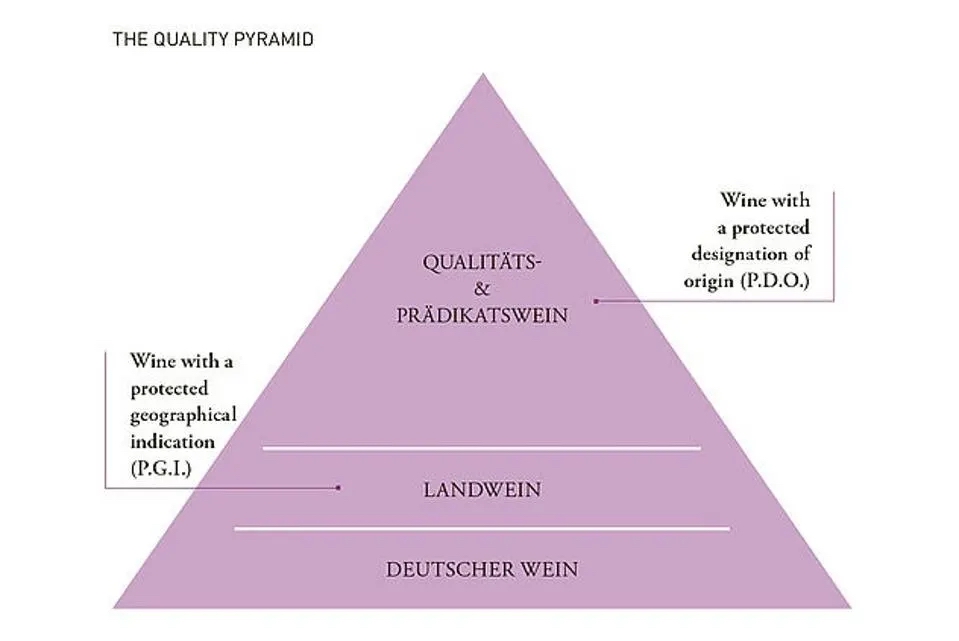
A new origins pyramid illustrates this. The base is Deutscher Wein (German wine, without a Protected Geographical Indication, or PGI to use EU-speak). The next tier is Landwein (regional wine, with a PGI). Above these are Prädikatswein and Qualitätswein (both wines with a Protected Designation of Origin, or PDO). The PDO category accounts for the majority of German wine production. Within this tier, the new law establishes four new narrowing levels of origin: wine-growing area, region, village, and vineyard.
Let’s take these one by one.
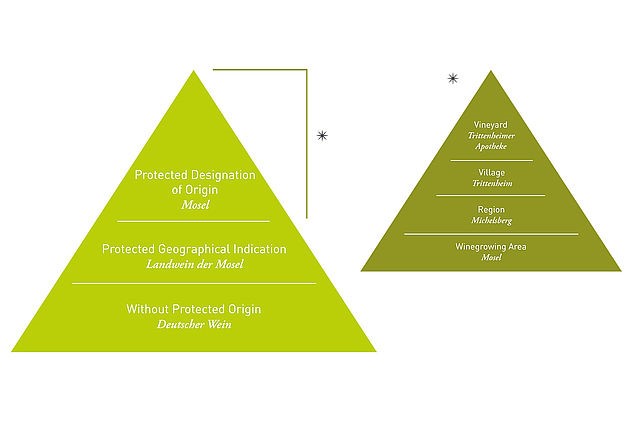
Wine-growing Area (Anbaugebiet) covers any one of Germany’s 13 designated wine-growing areas.
Region (Region, also in German) defines an area smaller than a Wine-growing Area: a Bereich (a district within a wine region) or Grosslage (a collective vineyard area). Region gains importance under the new law. If a Bereich or Grosslage is designated on a label, the German word “Region” must now appear immediately before it in the same font, color, and font size, no less — an apparent effort at transparency and consumer protection.
Village (Gemeinde/Ortsteil) sharpens the focus on the character of wines from a given commune or municipality. Under a long-standing “85-15 rule,” at least 85% of grapes must come from the village named on a wine’s label. But in a twist, the new law mandates geographic hyperspecificity.
This specificity raises a thorny issue for producers with vineyards that straddle multiple villages. Many do. The most visible example made German headlines. Piesporter Goldtröpfchen is an iconic Mosel vineyard. Because the vineyard (Goldtröpfchen) straddles the line between the villages of Piesport and Dhron, under the new law, wines sourced primarily from the Dhron side may have to go out into the world as “Drohner Goldtröpfchen.” Not quite the same ring, let alone prestige and pricing potential. (A leading German critic minced no words: “Without a measuring tape, the world remains inaccessible and incomprehensible to German bureaucracy,” Stephen Reinhardt wrote, lamenting “any sense of the bigger picture — indeed, of any sense at all.”) There have been more recent rumblings of plans to adjust this requirement.
Vineyard (Einzellage) is the apex of the origins pyramid. But! It is also the base tier of a brand-new pyramid. The vineyard level gives rise to two further levels: Erstes Gewächs (premier cru) and Grosses Gewächs (grand cru). The single-vineyard designations come with their own set of detailed production requirements. Here again, if a producer chooses to name a single vineyard, or a Gewann (the German equivalent of a lieu-dit, now permitted on labels, another novelty of the 2021 law) on a label, the name of the village or district must appear with it (again in matching color and font size).
Premier cru (Erstes Gewächs) and grand cru (Grosses Gewächs) are where things get sticky. To understand why, we need to rewind through a crucial period of German wine history.
From Private System to National Law
From the moment the 1971 wine law was enacted, the VDP understood the damage this legislation could do. As custodians of many of Germany’s most prized and historic vineyards, VDP members had a vested interest in seeing those sites formally recognized and protected. They evolved a plan.
“The basic idea,” says Steffen Christmann, current president of the VDP, “was that the connection between a grape variety, a grower, and a vineyard could be the catalyst for something that could recall the things that really matter, the things that made [German wines] great and important.”
Remarkably, the VDP turned to outside experts for guidance in creating its private classification system. British wine journalist, author, atlas maker, and champion of German wine, Hugh Johnson, stepped in. On the advice of Johnson and others, and in consultation with historical maps and other records, the VDP began the costly, time-intensive work of delineating many, though by no means all, of Germany’s great sites.
Learning from Cheese
Johnson injected a game-changing idea into discussions when he reminded VDP members about the classification criteria for Roquefort cheese: that it is not just a product from a particular place in France. It can only be Roquefort if made from sheep’s milk, from select breeds, on certain pastures, kept in specific caves for set lengths of time.
The VDP took this approach to heart. Erste Lagen and Grosse Lagen aren’t just lines on a map. They are the basis for designations, that govern permitted varieties, yields, harvest and production methods, and style, too.
The effort has paid off. Since their full launch in 2002, EGs and GGs have come to enjoy an excellent overall reputation globally. VDP members also enjoy prestige pricing for these top bottles.
A Fatal Flaw
There was, Christmann points out, just one problem: Erstes Gewächs and Grosses Gewächs are not trademarked terms. In 2021, the German government effectively repurposed them in a way that is certainly a high compliment to the VDP’s ideas and effort. But it is also a risky rip-off.
This sparked a debate over who gets to define German premier cru and grand cru status — and which criteria apply.
On one side is the VDP, defending the value of its classification system and the terms it elevated to international recognition. On the other is, essentially, everyone else in the German wine industry who wants a say in how EGs and GGs are determined and applied.
The politically influential DWV represents that majority. Christian Schwörer, who heads the DWV, says it respects what the VDP has built, but notes that the terms were never legally protected and have been used by producers outside the VDP system. Because the 2021 law opened these terms to all producers “without mandating a binding classification system,” the DWV now backs what Schwörer calls “a non-discriminatory system based on strict, clearly defined criteria” that is, in principle, open to all.
Part of the tension reflects the structure of German wine itself. Bulk producers and co-ops account for roughly three-quarters of German wine production. That means Germany’s independent estates — those with the most at stake in the EG and GG debate — produce just a quarter of the total.
“Many winegrowers, including some in the cooperatives, have not really given much thought to what it takes to produce a grand cru,” says Christmann of the VDP. “They often focus almost exclusively on purely technical parameters, such as yields per hectare, and still cling to the notion of a ‘selection wine’.”
Should grand crus be something that is available to everybody everywhere? “That might be one option,” he says. “However, it would not be in keeping with the truly established and successful grand crus on the international stage, and would undermine everything that has been achieved so far.”
Originally, the 2021 wine law envisioned giving that power to so-called Schutzgemeinschaften, or protective associations. Many industry watchers quietly wondered how these groups would carry out their freighted duties. Over the past year, it became clear that the task outstripped the associations’ capacities.
Intense closed-door negotiations followed. The final decision fell to the German Parliament. In mid-June, the Budestrat finally voted to approve a process for the classification of Erste and Grosse Lagen. Accordingly, the VDP and the DWV will take joint responsibility for establishing the criteria and making the determination of which sites qualify.
DWV Secretary General Schwörer said in a statement: “This lays the foundation for a non-discriminatory, transparent, and fair system that takes into account regional characteristics and the legitimate interests of genuinely committed producers — all within the framework of a uniform national system. This is a major responsibility that we intend to address and shape together with the industry.”
The new model is intended to be a distinctly German one: “A combination of the vineyard’s reputation, the reputation of the producers’ wine, and all of this based on the vineyard’s potential,” explains Christmann.
Full Roll Out Is Still Years Away
When vintage 2026 is harvested this autumn, most German growers still won’t be sure what sort of designation the wines will carry on release. EG and GG classification decisions are still years away and the process will likely happen in stages.
In a first step, says Schwörer, a committee set up by the VDP and DWV will assess and define vineyard sites based on specific criteria, in particular their established reputation and suitability for producing outstanding wines. In a subsequent step, he says, individual producers may apply for inclusion. (Who will pay for all this additional work is another matter.)
The long-term goal is a full-blown appellation system, “not only with the premier crus and grand crus,” says Christmann. This ambition has to be understood within the context of the German wine market: Until very recently, most producers acted as one-stop shops of wine styles for their predominantly local consumers: dry, sweet, white, pink, red, still, sparkling.
That model is broken. “There is no future for a producer to sell a very broad range of wines only for the German market,” says Christmann. “There will be a need for more exports and people start to understand that for a consumer in New York or Shanghai, the diversity within a single producer’s portfolio and from an appellation may be a disadvantage.”
The Bundesrat’s decision clears a highly visible hurdle to moving forward with implementing the new law. But it also sets up what might be a lifetime of work, and ongoing debate, on just what constitutes a great site in Germany.
Stay tuned.
Where does that leave us, as consumers and trade? Essentially, with a handful of new terms to learn, a few new pyramids to memorize — and permission, for now, to sit back with a few good vineyard maps and a glass of great German wine, piecing together the jigsaw puzzle of how our own tastes line up with all these competing ideas.
Remember: there’s always Landwein.